
What Is Agentic AI? A Practical Guide for Business Owners
Agentic AI is changing how businesses operate. Learn what it is, how it works, and why San Diego companies are adopting it to automate complex workflows. description.
3/12/20263 min read
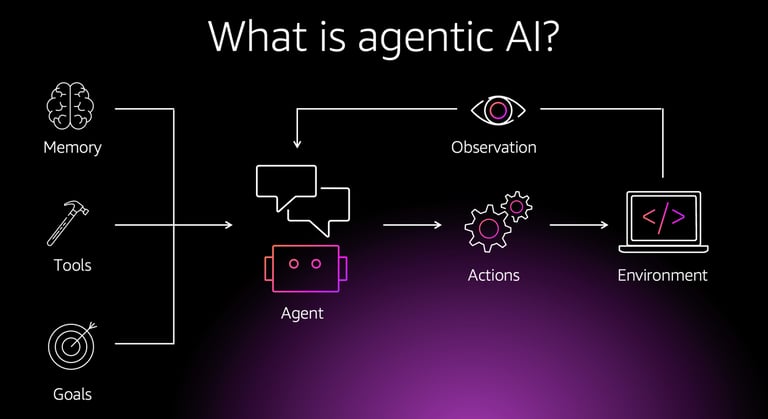
There is a new term making rounds in every boardroom, pitch deck, and LinkedIn post: agentic AI. If you have been paying attention to AI trends in 2026, you have probably seen it mentioned alongside predictions from PwC, IBM, and every major consulting firm. But most explanations are written for engineers. This one is written for you — the person running a business who needs to understand what it actually means and whether it matters.
The Simple Explanation
Traditional AI tools respond. You give ChatGPT a prompt, it gives you an answer. You ask a chatbot a question, it replies. That is reactive AI. It waits for input and produces output. Agentic AI does not wait. It acts. An agentic AI system can receive a goal, break it into steps, decide how to accomplish each step, use tools and data sources along the way, and deliver a result — without someone sitting there managing every move.
Think of it like the difference between a calculator and an employee. A calculator gives you an answer when you type in a problem. An employee takes a task, figures out how to get it done, coordinates with other people, and comes back with a finished result. Agentic AI is the employee.
What This Looks Like in a Real Business
Forget the theory. Here is what agentic AI looks like when it is actually running inside a company.
A lead fills out a form on your website. An agentic system picks it up, checks your CRM to see if the lead already exists, scores the lead based on your criteria, sends a personalized follow-up email, and books a discovery call on your calendar. All of that happens in under sixty seconds with zero human involvement.
Or consider inbound phone calls. A voice AI agent answers, understands why the person is calling, pulls up their account information, resolves routine questions, and only transfers to a human when the issue genuinely requires one. The rest of the time, it handles everything autonomously.
These are not hypothetical scenarios. These are systems running in production right now for businesses across San Diego and Southern California.
Why 2026 Is the Tipping Point
Agentic AI has existed in concept for years, but 2026 is when it becomes practical for mid-sized businesses. Three things changed. First, the underlying language models got reliable enough to make decisions without constant supervision. Second, the tools for connecting AI to business systems like CRMs, phone systems, and databases matured. Third, the cost dropped to where a ten-person company can afford what used to require an enterprise budget.
PwC called 2026 the year agents will finally deliver measurable value. IBM is predicting smaller, domain-specific AI models that are tuned for specific business workflows. The infrastructure caught up to the ambition.
Agentic AI vs. Traditional Automation
If you have used Zapier or built workflows in your CRM, you have used traditional automation. It follows rules: if this happens, do that. It works well for simple, predictable tasks. But it breaks the moment something unexpected comes up.
Agentic AI handles the unexpected. It can interpret context, make judgment calls, and adapt its approach based on what it finds. If a customer replies to a follow-up email with a question the system was not specifically programmed for, an agentic system reads the question, finds the answer, and responds appropriately. A traditional automation just stops.
Is Your Business Ready for Agentic AI?
Not every business needs agentic AI today. But if any of the following sound familiar, you are a candidate. Your team spends hours every week on repetitive tasks that follow a similar pattern. Leads fall through the cracks because follow-up depends on someone remembering to do it. Your phone rings and nobody answers because everyone is busy. Customer service requests pile up and response times are getting longer. You have tried basic automation but keep hitting walls with anything more complex.
If even two of those apply, agentic AI can probably save you more time and money than you expect.
Where to Start
The best approach is to pick one workflow that is clearly manual, clearly repetitive, and clearly costing you time or revenue. Start there. Get it running in production. Measure the results. Then expand.
At DSE Group, that is exactly how we work. We identify the highest-impact process, build the agentic system, deploy it into your live business, and measure what changed. No proof of concepts. No six-month roadmaps. Just systems that ship and run.
If you want to explore whether agentic AI makes sense for your business, book a 30-minute discovery call HERE. We will tell you honestly whether it fits or whether you should wait.